

Is The Mobile Cleaner Fast Repair A Scam
What is the Cleaner Update scam?
Information technology is the name of a scam targeting Android users. The scheme is promoted on various deceptive websites. It attempts to fob users into downloading/installing and/or purchasing dubious software by claiming that it is necessary to continue watching online content in "safe style".
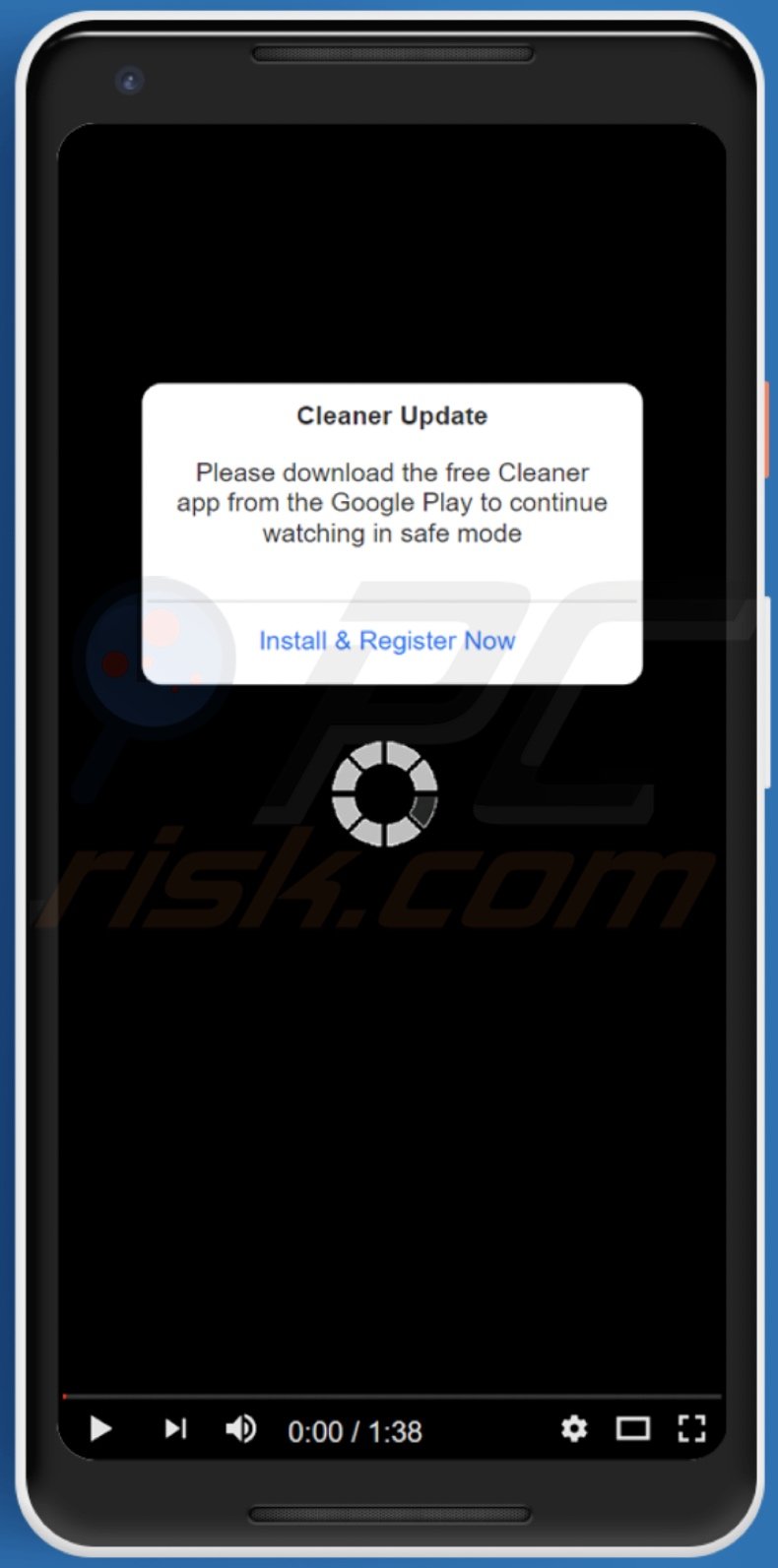
Cleaner Update pop-up scam in item
When a website running the "Cleaner Update" scam is accessed, it presents visitors with a pop-up window that contains a brief bulletin. The text in the popular-up states that a new update for the company'due south cleaner software is available.
The scheme then requests the user to download a "free Cleaner app" in society to proceed watching (online content) in "safe manner". It must be emphasized that the claims made by "Cleaner Update" are false. Therefore, installing the software promoted through such schemes tin result in a wide variety of issues.
Scams of this kind typically endorse fake anti-viruses, adware, browser hijackers, and other PUAs (Potentially Unwanted Applications). However, the schemes may proliferate trojans, ransomware, cryptocurrency miners, and other malware equally well.
It is noteworthy that users seldom access untrustworthy sites intentionally. Most enter them via mistyped URLs, or redirects caused by rogue pages, intrusive advertisements, or installed PUAs.
More than data about potentially unwanted applications
As mentioned in the introduction, deceptive sites similar those running the "Cleaner Update" scam usually promote various PUAs. This software appears legitimate and harmless. Unwanted apps lure users with promises of "useful" and "advantageous" functionalities, which are seldom operational.
Simulated anti-virus tools are a prime example of this type; they crave activation (i.e., purchase) to perform the advertised features, yet later on activation - they remain nonoperational.
Furthermore, PUAs typically accept harmful abilities. Some of these applications tin force-open unreliable and malicious websites. Adware-types run intrusive ad campaigns. When clicked on, the delivered adverts redirect to untrustworthy/dangerous webpages, and some can stealthily download/install software.
Browser hijackers modify browser settings to promote fake search engines. These web searchers are rarely able to provide search results, so they redirect to Google, Yahoo, Bing, and other genuine search engines.
What is more, most PUAs (regardless of type) have data tracking functionalities. Information of interest includes: URLs visited, pages viewed, search queries typed, IP addresses/ geolocations, personally identifiable details, finance-related data, and and so along. The collected data is monetized by being shared with and/or sold to tertiary-parties.
In summary, the presence of unwanted apps on devices tin result in arrangement infections, astringent privacy issues, financial losses, and even identity theft. To ensure device integrity and user privacy, all suspicious applications and browser extensions/plug-ins must be removed immediately upon detection.
| Name | Cleaner Update pop-up |
| Threat Type | Android malware, malicious application, unwanted awarding. |
| Related Domains | glbltraffic[.]com |
| Detection Names | Forcepoint ThreatSeeker (Suspicious), Total List (VirusTotal) |
| Symptoms | The device is running slow, system settings are modified without user's permission, questionable applications appear, information and battery usage is increased significantly, browsers redirect to questionable websites, intrusive advertisements are delivered. |
| Distribution methods | Infected e-mail attachments, malicious online advertisements, social technology, deceptive applications, scam websites. |
| Damage | Stolen personal information (individual messages, logins/passwords, etc.), decreased device performance, bombardment is drained quickly, decreased Internet speed, huge data losses, monetary losses, stolen identity (malicious apps might abuse communication apps). |
| Malware Removal (Android) | To eliminate malware infections our security researchers recommend scanning your Android device with legitimate anti-malware software. We recommend Avast, Bitdefender, ESET or Malwarebytes. |
Online scams in general
"Cleanup required correct now!" and "Your chrome Device may be also old" are a couple examples of Android-targeting scams. Popular scam models include (but are not express to): alerts that a slice of essential software is outdated or missing, warnings that the device is infected or at chance, fake prize giveaways, and ludicrous deals.
The Internet is rife with misleading, deceptive, and even malicious content. Due to the prevalence of online scams, it is strongly recommended to exercise caution when browsing.
How did potentially unwanted applications install on my figurer?
Some PUAs have "official" promotional/download sites, which are often pushed by deceptive/scam ones. These applications are also spread via intrusive advertisements. One time clicked on, the ads can execute scripts to make stealthy downloads/installations.
PUAs are most commonly distributed through downloaders/installers of other programs. "Bundling" is the name of this false marketing technique - packing regular software with unwanted or malicious additions. Rushed downloads/installations (e.g., skipped steps, etc.) increment the risk of allowing bundled content into the device.
How to avoid installation of potentially unwanted applications?
It is advised to inquiry software before download/installation. Additionally, all downloads must be performed from official and verified sources. Untrustworthy download channels, eastward.g., unofficial and free file-hosting sites, Peer-to-Peer sharing networks, and other third-party downloaders - often offer bundled and hazardous content.
When downloading/installing, it is recommended to read terms, report available options, utilize the "Custom/Advanced" settings to opt-out from additional apps, features, etc. Intrusive ads appear legitimate; all the same, they redirect to highly questionable websites (e.thousand., gambling, pornography, adult-dating, so on).
In case of encounters with advertisements and/or redirects of this kind, the device must exist checked and all doubtable applications and browser extensions/plug-ins detected - removed from it without delay.
Text presented in the "Cleaner Update" scam pop-up window:
Cleaner Update
Please download the free Cleaner app from the Google Play to continue watching in safe modeInstall & Register Now
0:00 / 1:38
Quick menu:
- Introduction
- How to delete browsing history from the Chrome spider web browser?
- How to disable browser notifications in the Chrome web browser?
- How to reset the Chrome web browser?
- How to delete browsing history from the Firefox web browser?
- How to disable browser notifications in the Firefox spider web browser?
- How to reset the Firefox web browser?
- How to uninstall potentially unwanted and/or malicious applications?
- How to boot the Android device in "Condom Mode"?
- How to bank check the bombardment usage of various applications?
- How to check the information usage of various applications?
- How to install the latest software updates?
- How to reset the system to its default state?
- How to disable applications that have ambassador privileges?
Delete browsing history from the Chrome spider web browser:
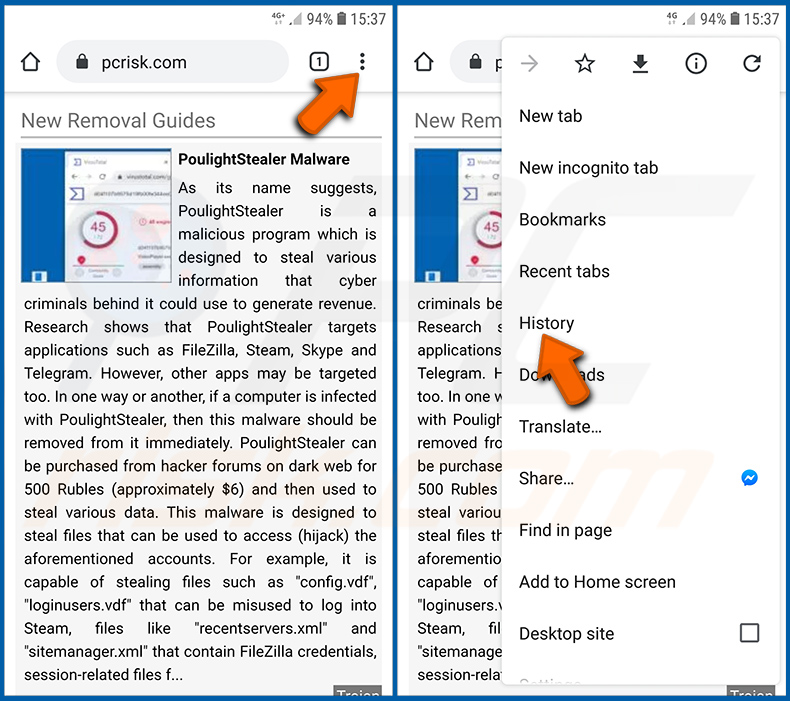
Tap the "Carte" push (three dots on the right-upper corner of the screen) and select "History" in the opened dropdown menu.
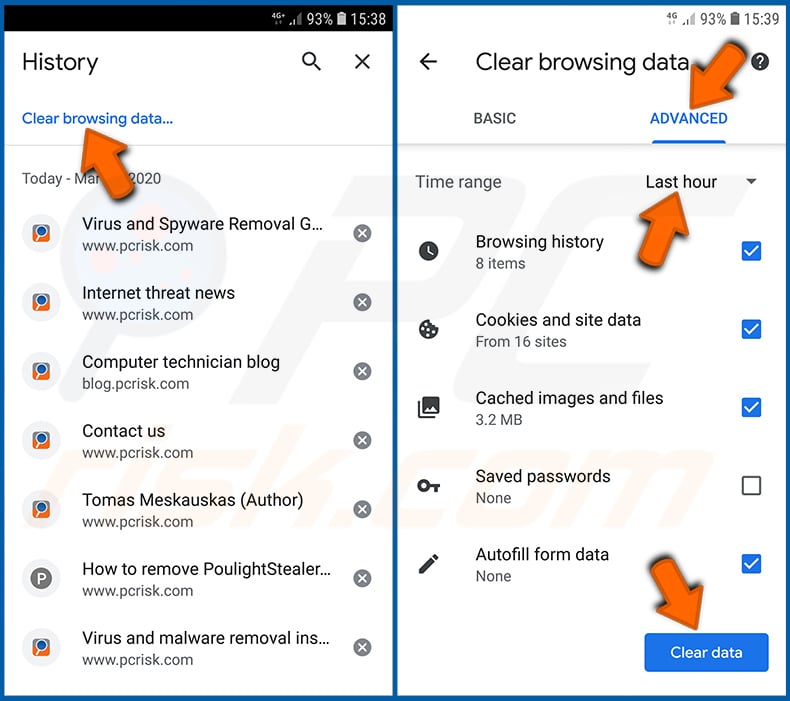
Tap "Clear browsing data", select "Advanced" tab, choose the time range and data types y'all want to delete and tap "Clear data".
[Back to Tabular array of Contents]
Disable browser notifications in the Chrome web browser:
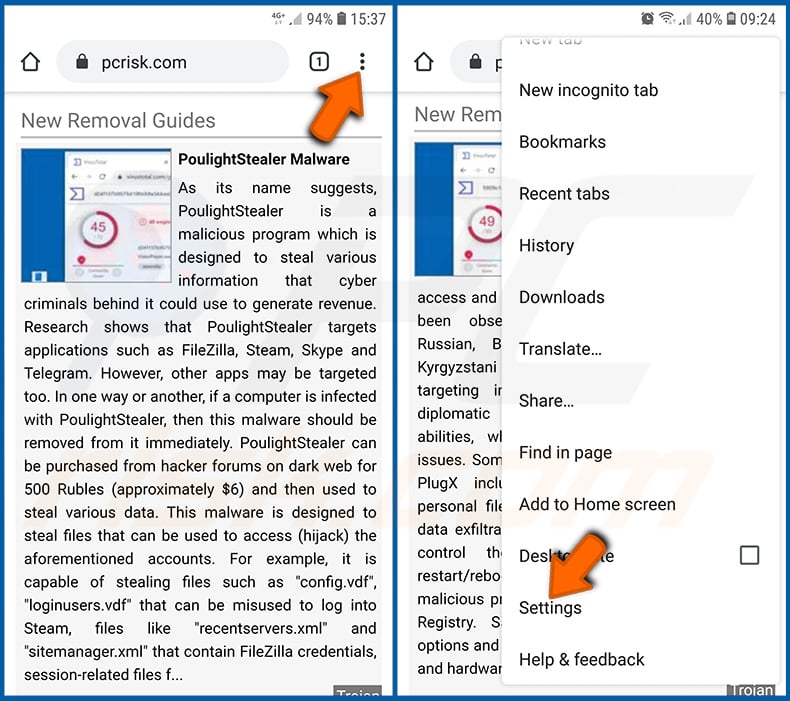
Tap the "Menu" push button (three dots on the right-upper corner of the screen) and select "Settings" in the opened dropdown bill of fare.
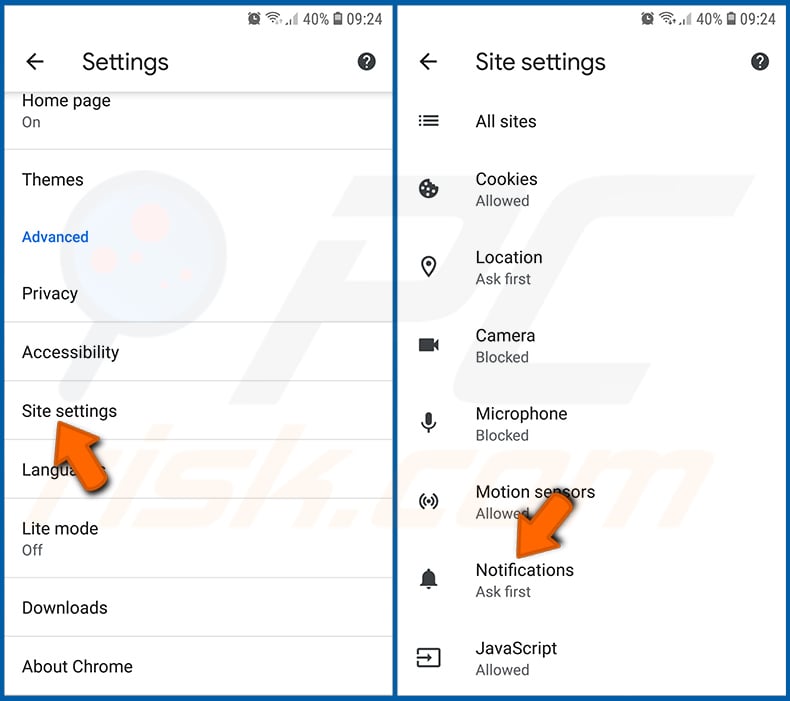
Scroll downwards until you lot see "Site settings" option and tap it. Ringlet downwards until you see "Notifications" choice and tap information technology.
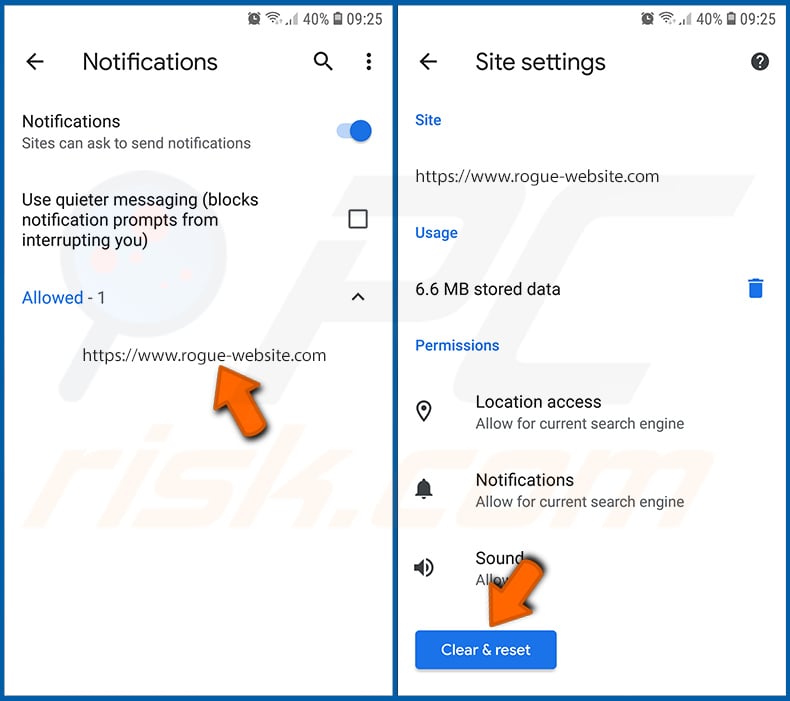
Find the websites that deliver browser notifications, tap on them and click "Clear & reset". This will remove permissions granted for these websites to evangelize notifications. However, once y'all visit the same site once more, it may enquire for a permission over again. You can choose whether to give these permissions or not (if you choose to decline the website will go to "Blocked" section and volition no longer ask you for the permission).
[Back to Table of Contents]
Reset the Chrome web browser:
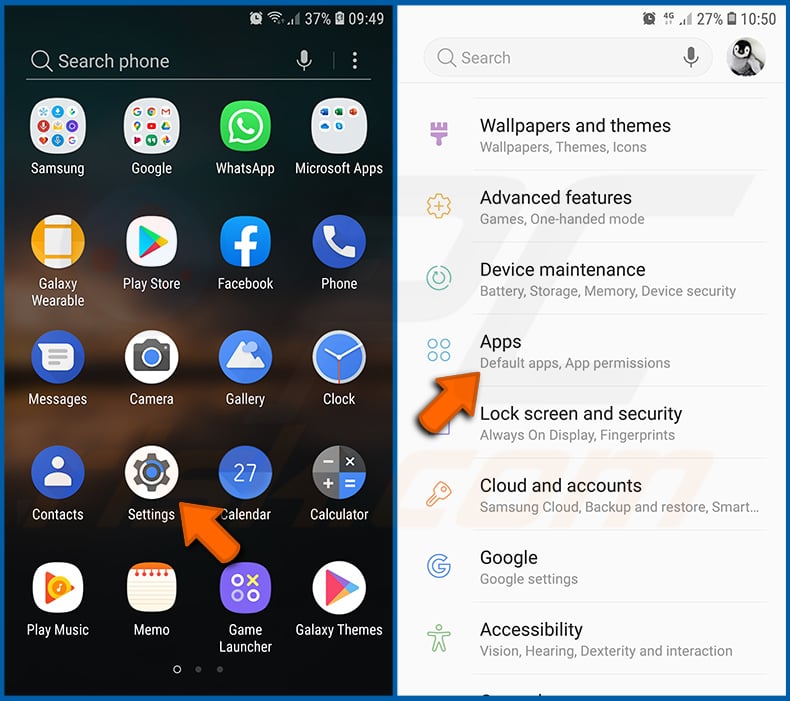
Become to "Settings", gyre downwardly until you lot see "Apps" and tap it.
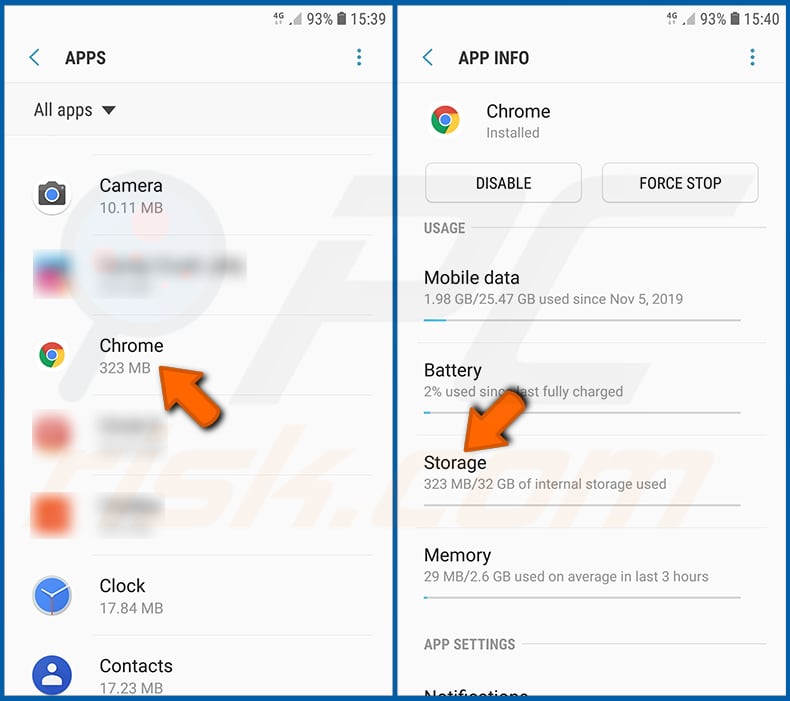
Ringlet down until y'all observe "Chrome" application, select it and tap "Storage" option.
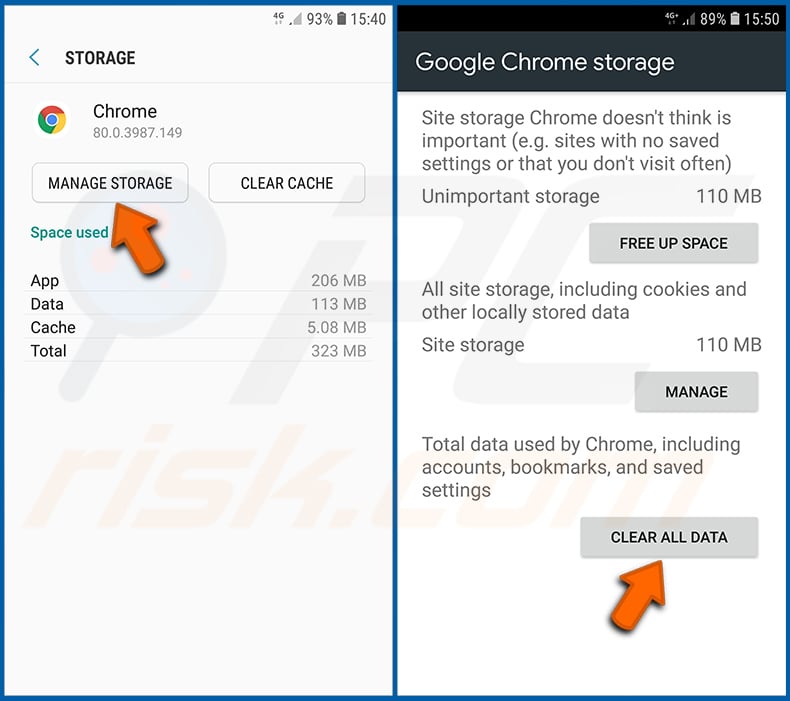
Tap "MANAGE STORAGE", then "CLEAR ALL DATA" and confirm the action by taping "OK". Note that resetting the browser will eliminate all data stored inside. This means that all saved logins/passwords, browsing history, non-default settings and other data will be deleted. You will also have to re-login into all websites too.
[Back to Table of Contents]
Delete browsing history from the Firefox web browser:
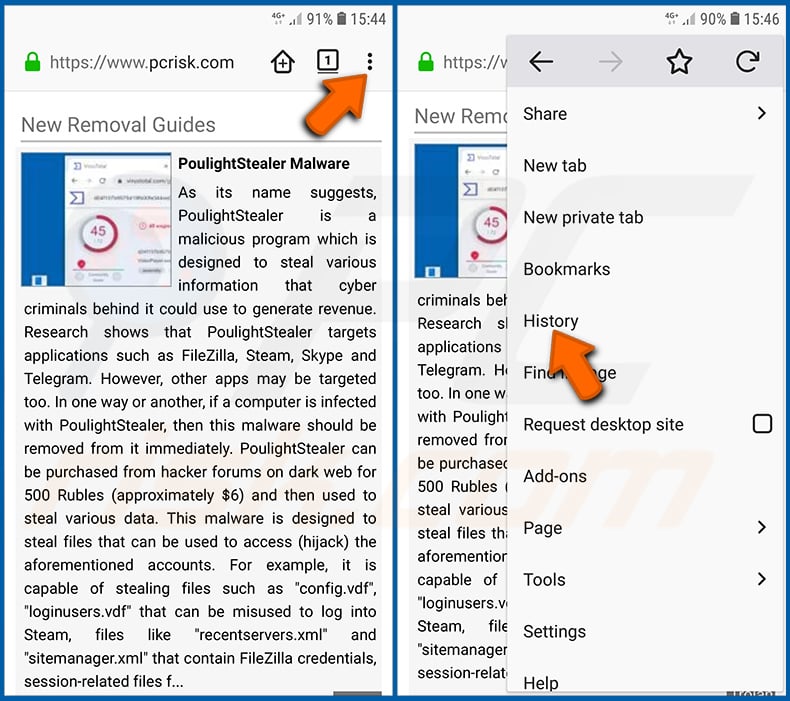
Tap the "Card" button (three dots on the right-upper corner of the screen) and select "History" in the opened dropdown menu.
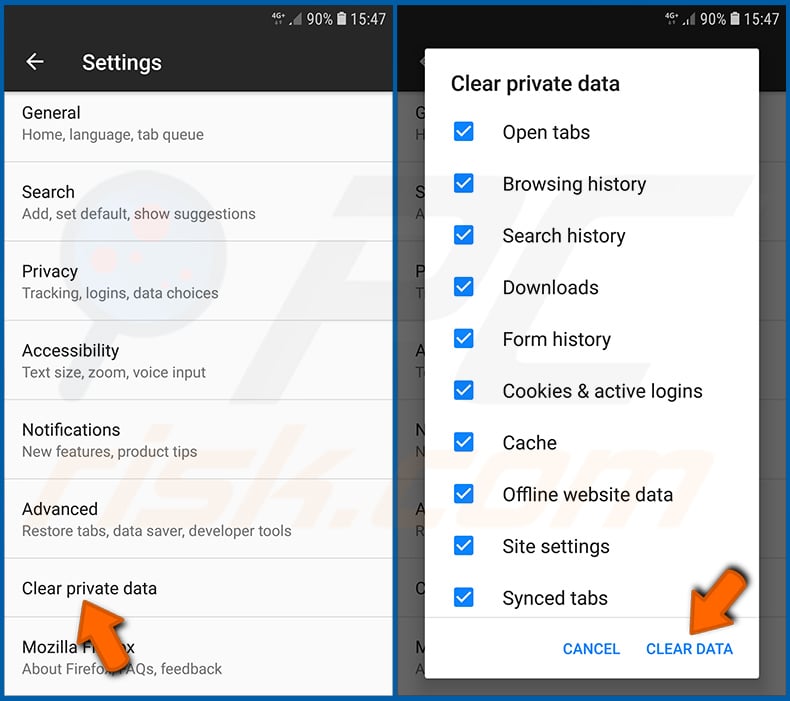
Scroll down until you see "Clear private data" and tap it. Select data types you want to remove and tap "Clear Data".
[Back to Table of Contents]
Disable browser notifications in the Firefox web browser:
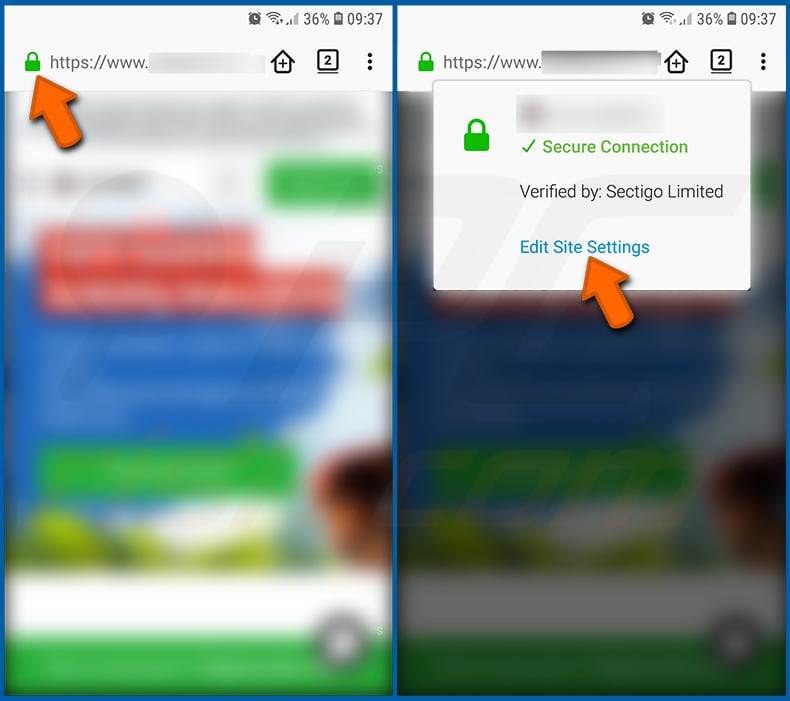
Visit the website that is delivering browser notifications, tap the icon displayed on the left of URL bar (the icon will not necessarily be a "Lock") and select "Edit Site Settings".
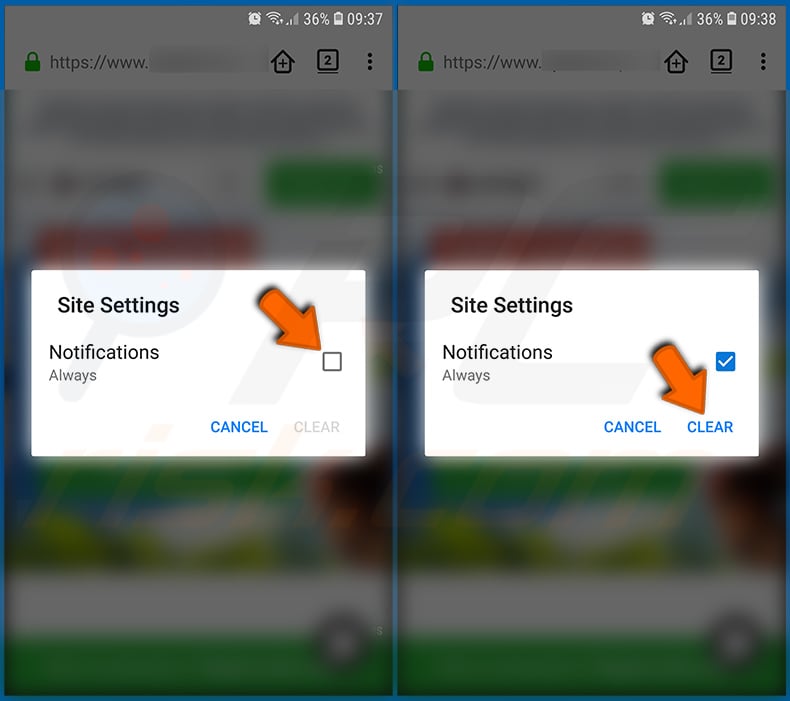
In the opened pop-up opt-in the "Notifications" pick and tap "Clear".
[Back to Table of Contents]
Reset the Firefox web browser:
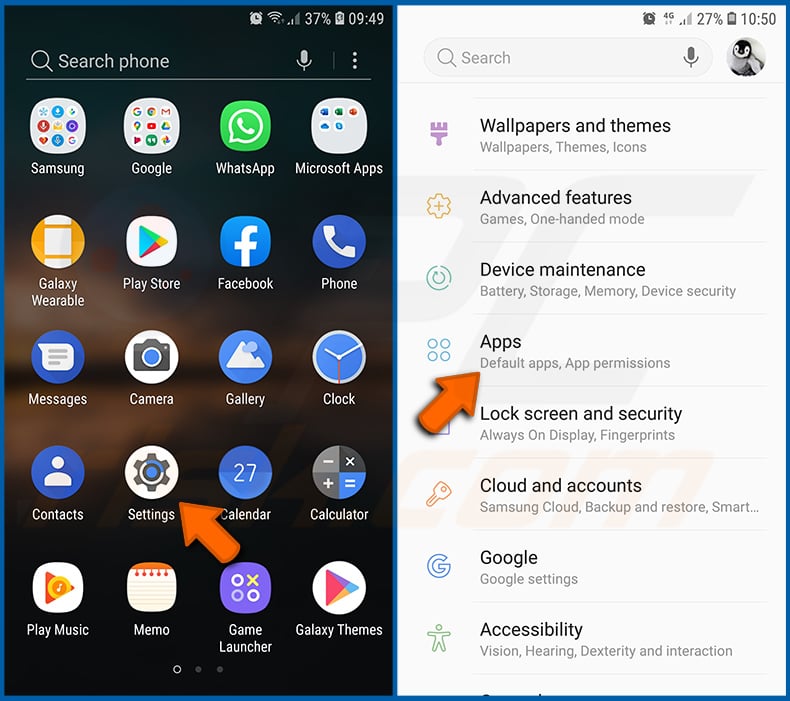
Go to "Settings", scroll downwards until you come across "Apps" and tap it.
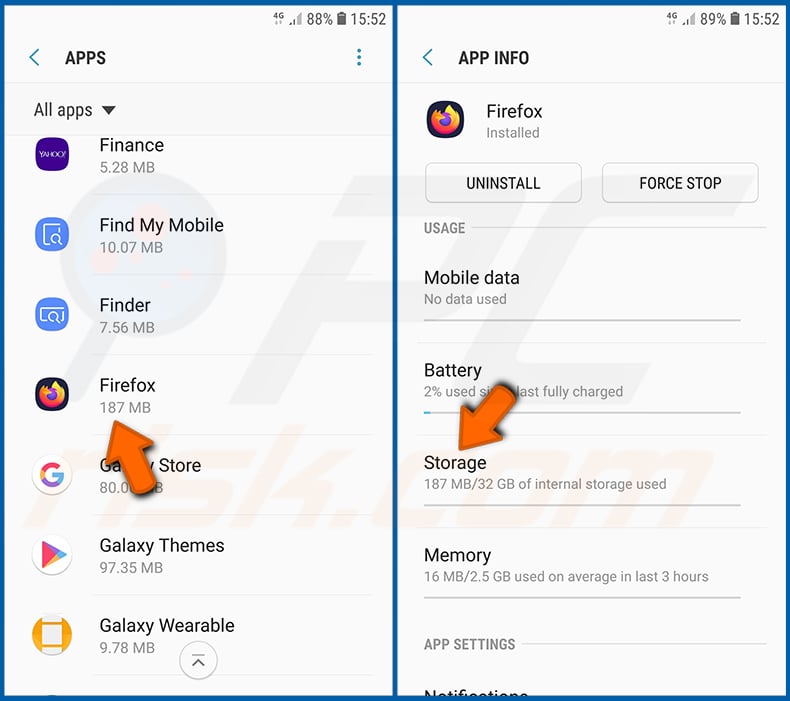
Scroll down until you find "Firefox" awarding, select it and tap "Storage" option.
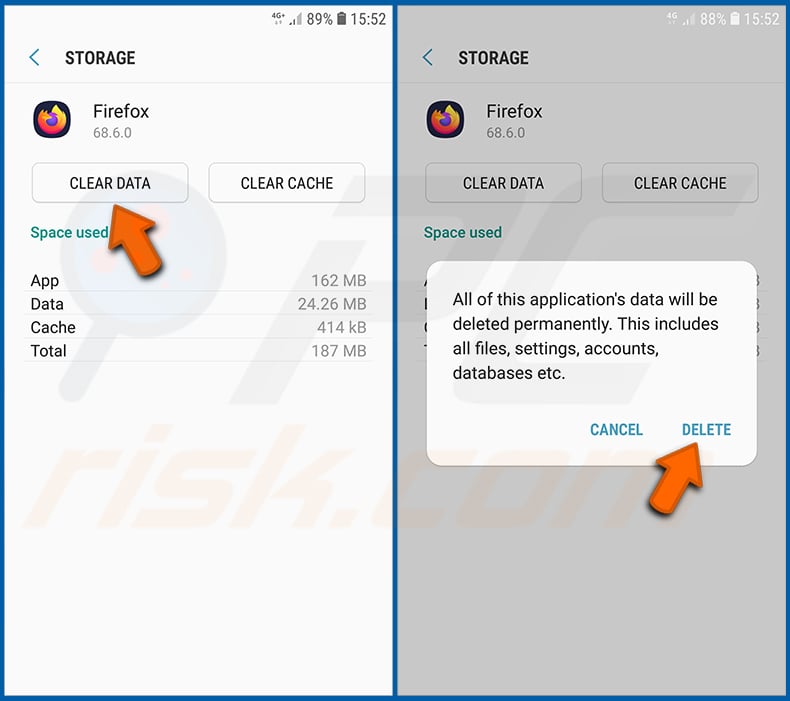
Tap "Clear DATA" and confirm the action past taping "DELETE". Note that resetting the browser will eliminate all information stored within. This means that all saved logins/passwords, browsing history, non-default settings and other data will be deleted. Yous volition as well have to re-login into all websites as well.
[Dorsum to Table of Contents]
Uninstall potentially unwanted and/or malicious applications:
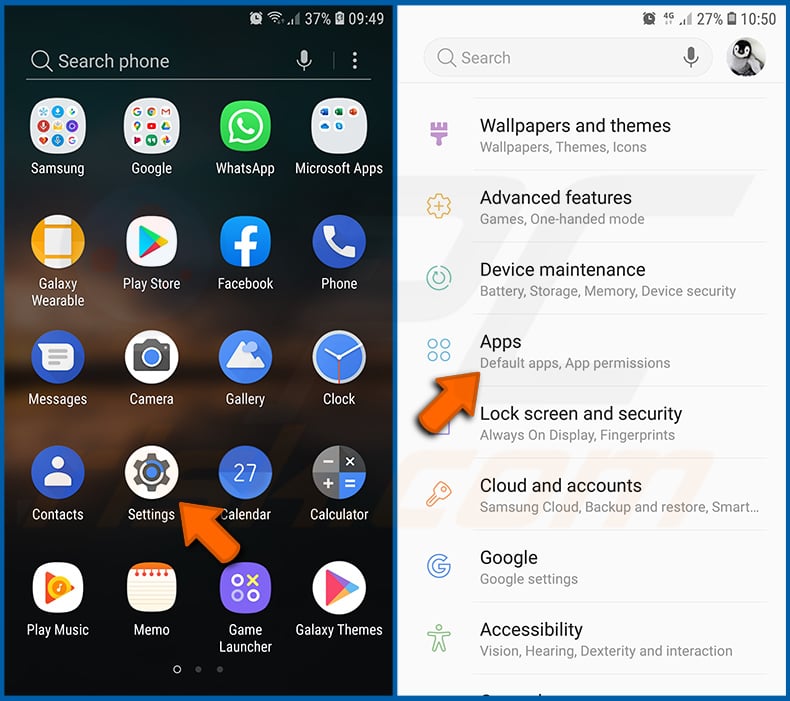
Become to "Settings", whorl down until you lot see "Apps" and tap it.
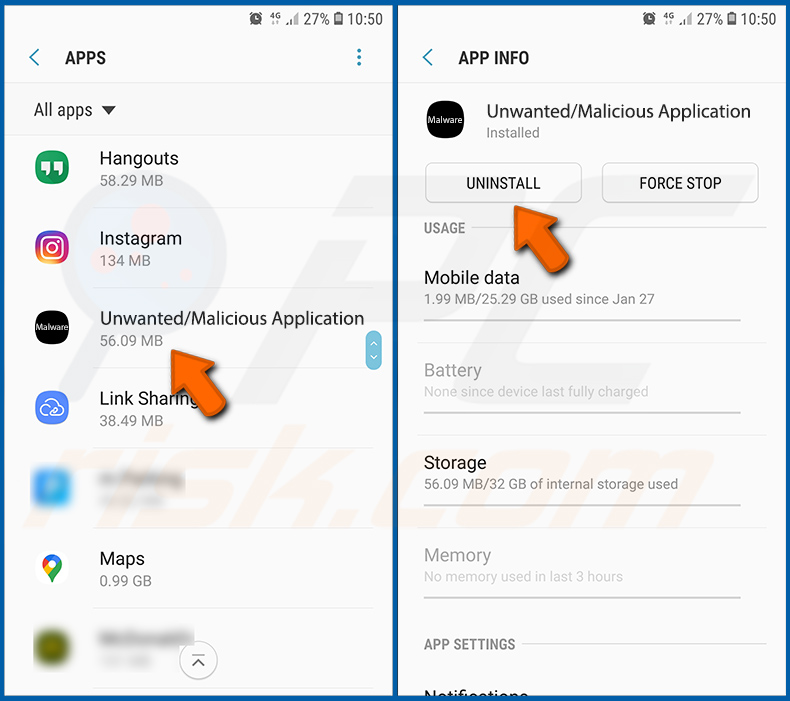
Scroll down until y'all see a potentially unwanted and/or malicious application, select it and tap "Uninstall". If, for some reason, you are unable to remove the selected app (e.k., you lot are prompted with an error message), y'all should try using the "Safe Mode".
[Back to Table of Contents]
Boot the Android device in "Rubber Manner":
The "Safe Mode" in Android operating organization temporarily disables all tertiary-political party applications from running. Using this mode is a good manner to diagnose and solve various issues (east.g., remove malicious applications that forbid users you from doing so when the device is running "commonly").
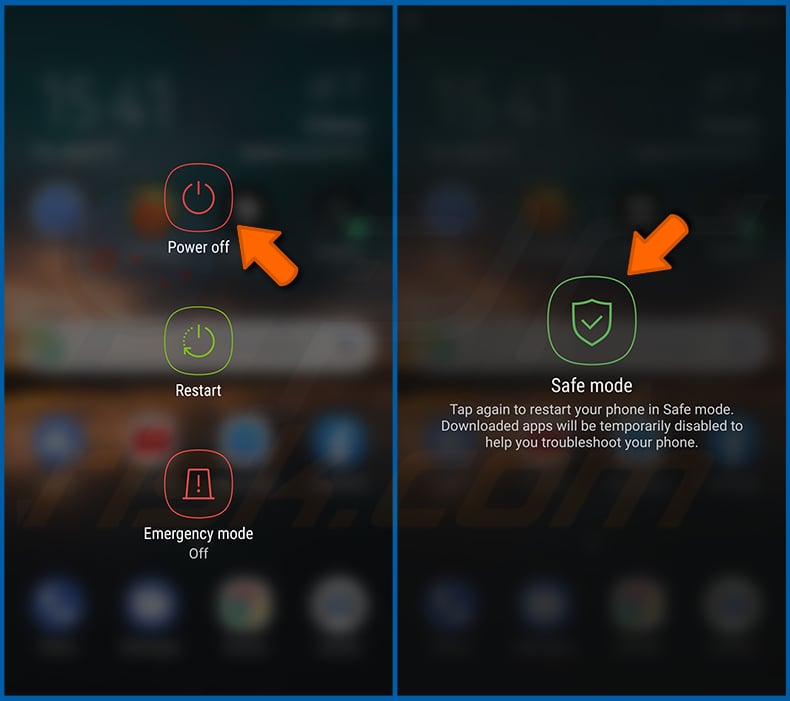
Push button the "Power" push button and hold it until you come across the "Ability off" screen. Tap the "Ability off" icon and concord it. After a few seconds the "Safe Mode" choice volition appear and yous'll exist able run it past restarting the device.
[Dorsum to Table of Contents]
Check the battery usage of various applications:
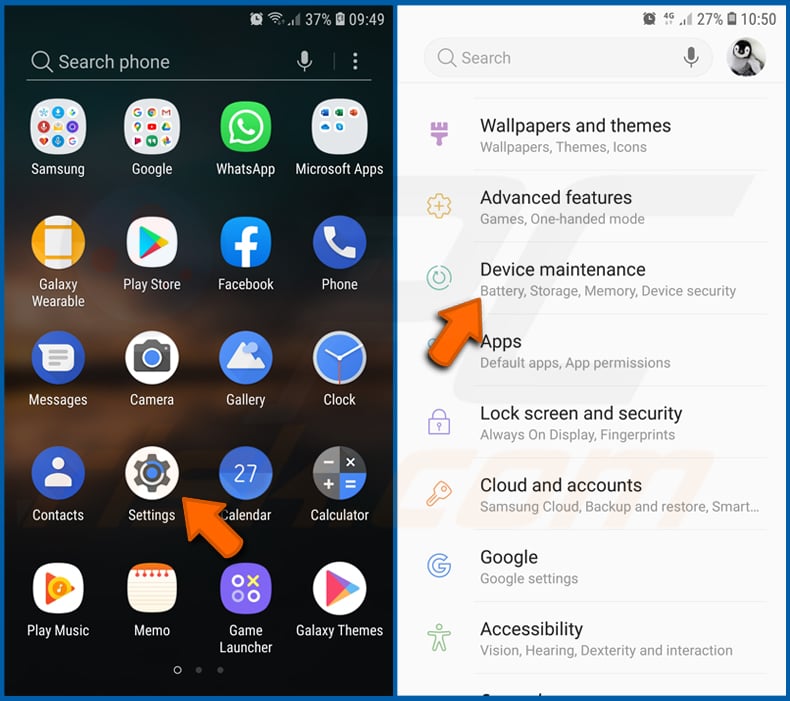
Get to "Settings", scroll down until you meet "Device maintenance" and tap it.
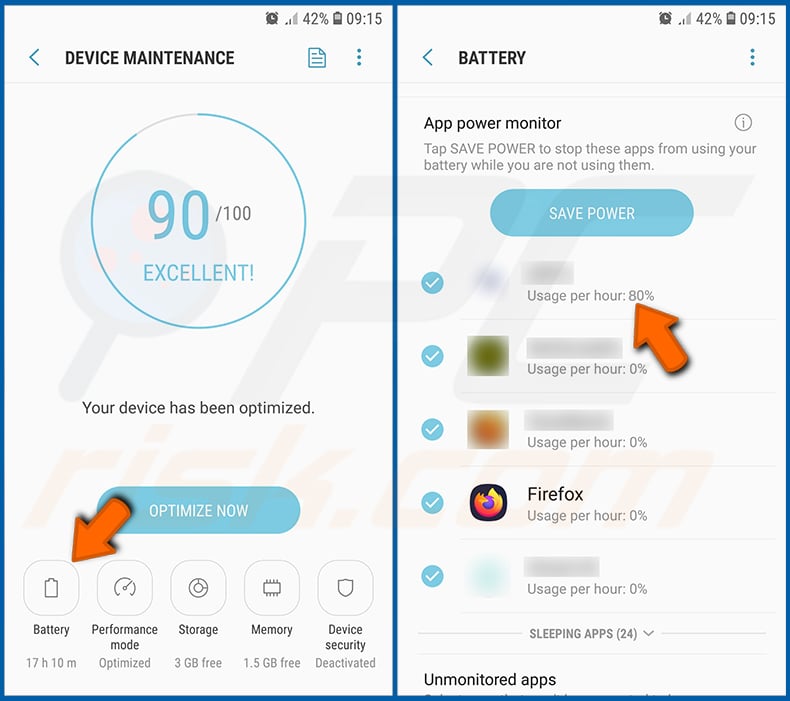
Tap "Battery" and bank check the usage of each application. Legitimate/genuine applications are designed to use every bit depression free energy as possible in order to provide the all-time user experience and to salve ability. Therefore, loftier bombardment usage may signal that the application is malicious.
[Back to Tabular array of Contents]
Bank check the data usage of various applications:
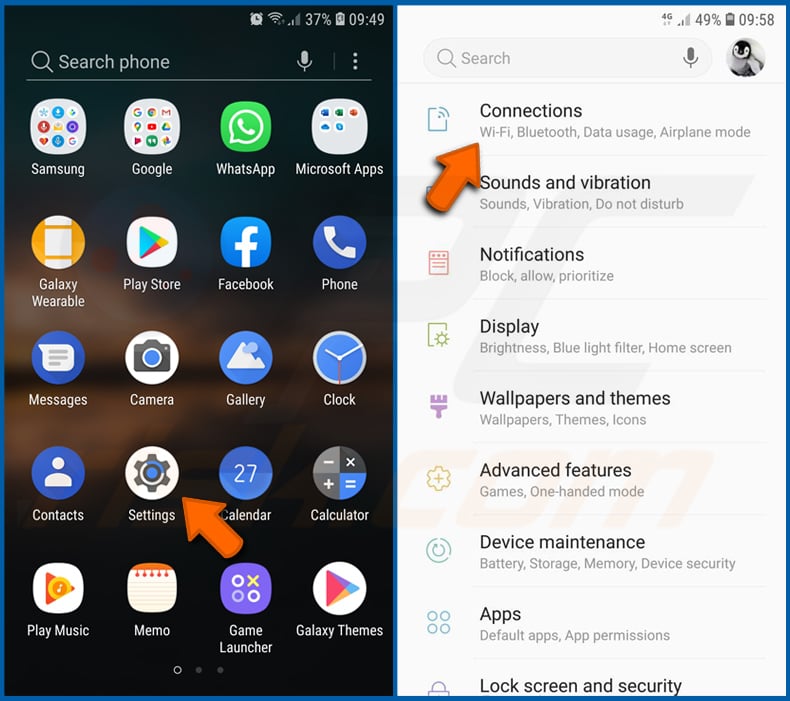
Go to "Settings", gyre down until y'all run across "Connections" and tap it.
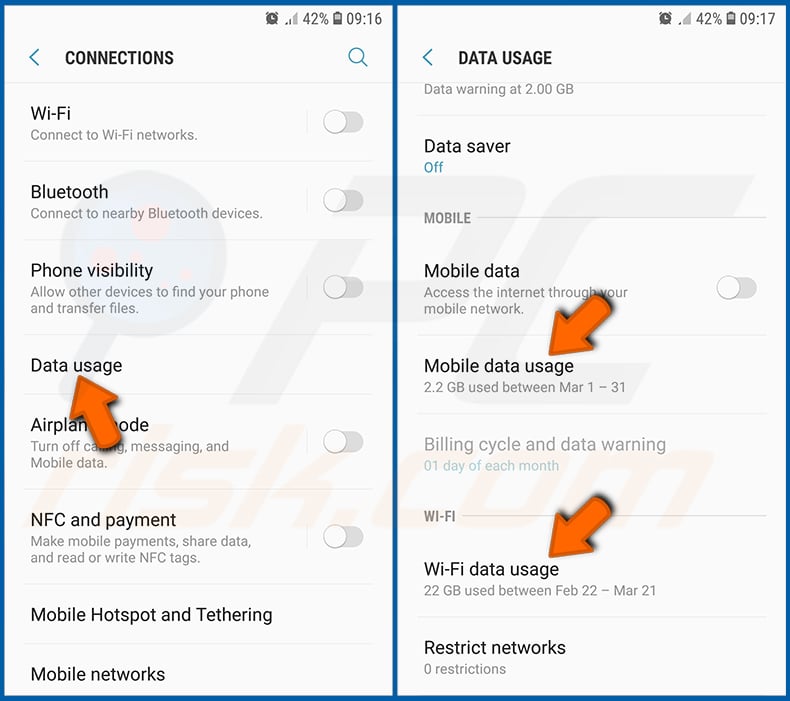
Scroll downwardly until you see "Data usage" and select this option. As with battery, legitimate/genuine applications are designed to minimize data usage as much as possible. This ways that huge data usage may indicate presence of malicious application. Note that some malicious applications might be designed to operate when the device is connected to wireless network but. For this reason, you lot should check both Mobile and Wi-Fi data usage.
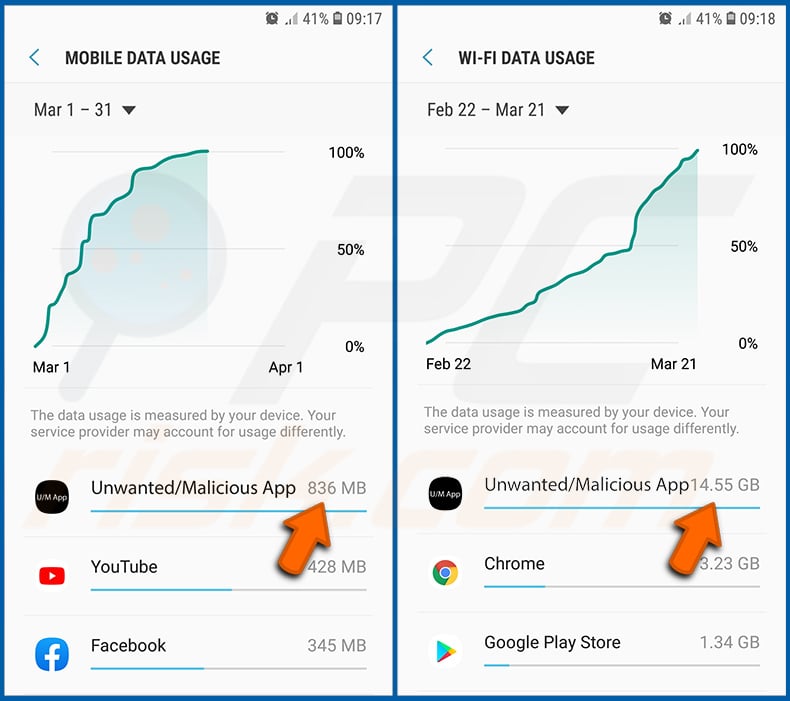
If you notice an application that uses a lot of data even though you never apply information technology, then we strongly suggest y'all to uninstall it as shortly equally possible.
[Back to Table of Contents]
Install the latest software updates:
Keeping the software up-to-date is a good do when information technology comes to device safety. The device manufacturers are continually releasing various security patches and Android updates in order to fix errors and bugs that tin be abused by cyber criminals. An outdated system is way more vulnerable, which is why you lot should always be sure that your device's software is up-to-date.
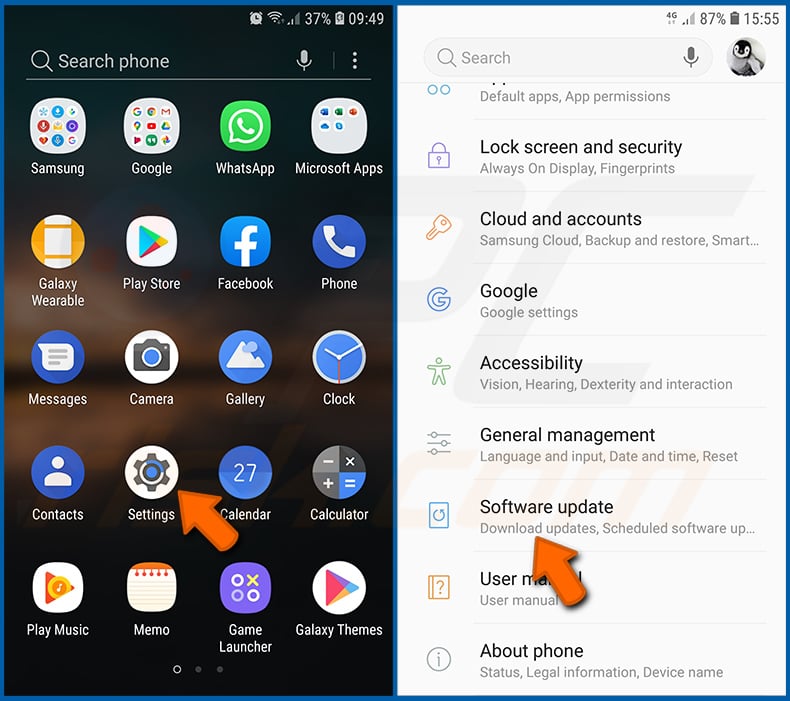
Become to "Settings", curl down until you run across "Software update" and tap information technology.
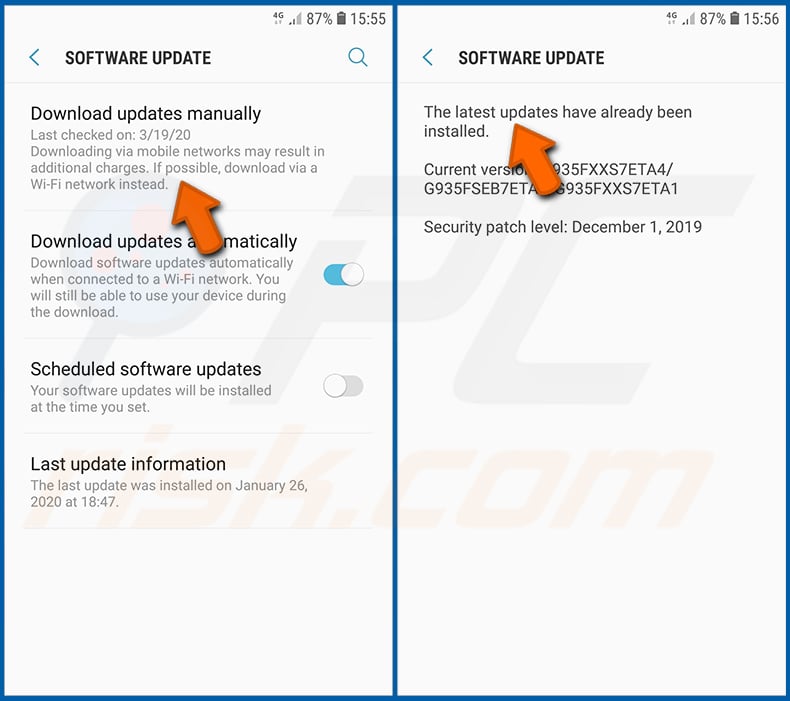
Tap "Download updates manually" and check if at that place are any updates bachelor. If so, install them immediately. We besides recommend to enable the "Download updates automatically" option - it volition enable the organisation to notify you once an update is released and/or install it automatically.
[Back to Table of Contents]
Reset the system to its default state:
Performing a "Manufacturing plant Reset" is a good way to remove all unwanted applications, restore organisation's settings to default and clean the device in general. Yet, you must keep in mind that all data within the device will be deleted, including photos, video/sound files, telephone numbers (stored inside the device, non the SIM card), SMS messages, and and so forth. In other words, the device volition be restored to its primal country.
You lot can also restore the bones system settings and/or simply network settings as well.
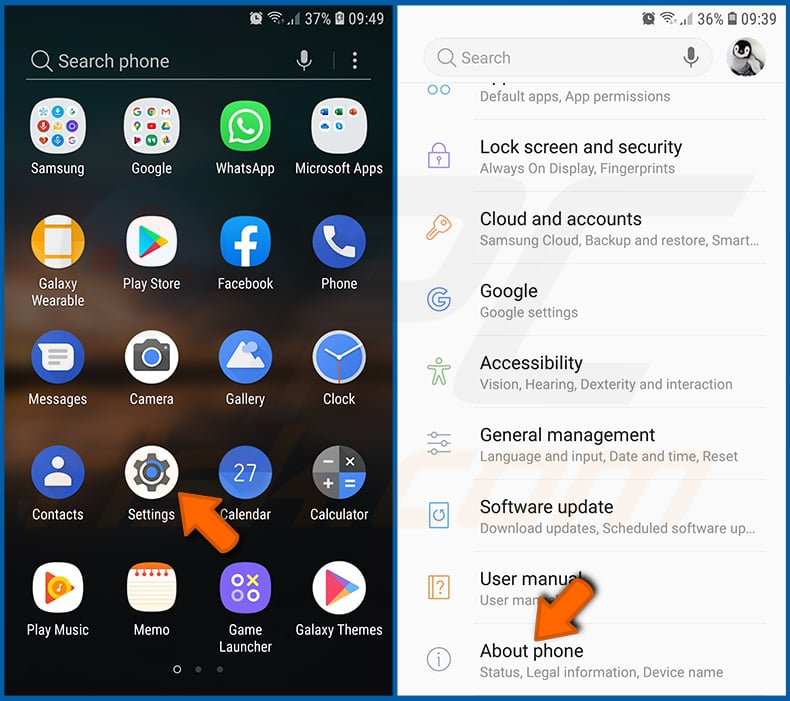
Go to "Settings", roll down until you see "About phone" and tap it.
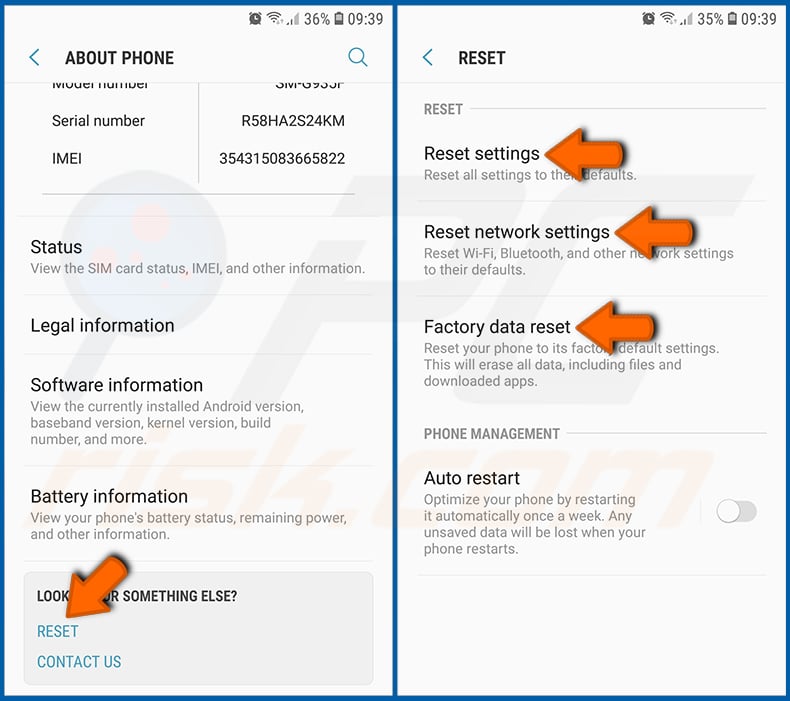
Coil downward until y'all come across "Reset" and tap it. At present choose the action you lot desire to perform:
"Reset settings" - restore all system settings to default;
"Reset network settings" - restore all network-related settings to default;
"Factory information reset" - reset the entire system and completely delete all stored data;
[Back to Table of Contents]
Disable applications that accept ambassador privileges:
If a malicious application gets administrator-level privileges it can seriously damage the system. To keep the device equally safe equally possible yous should always cheque what apps have such privileges and disable the ones that shouldn't.
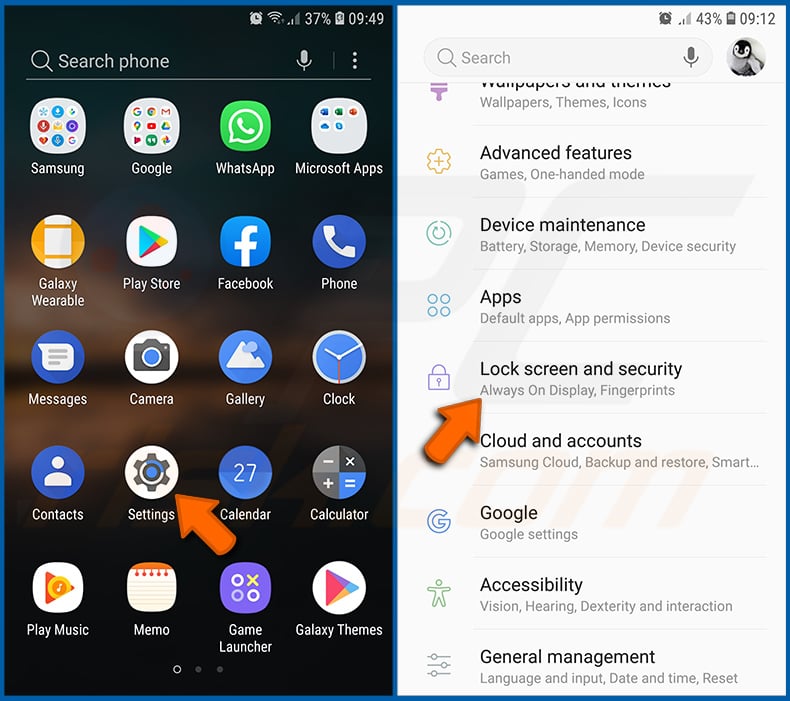
Go to "Settings", coil down until you run into "Lock screen and security" and tap it.
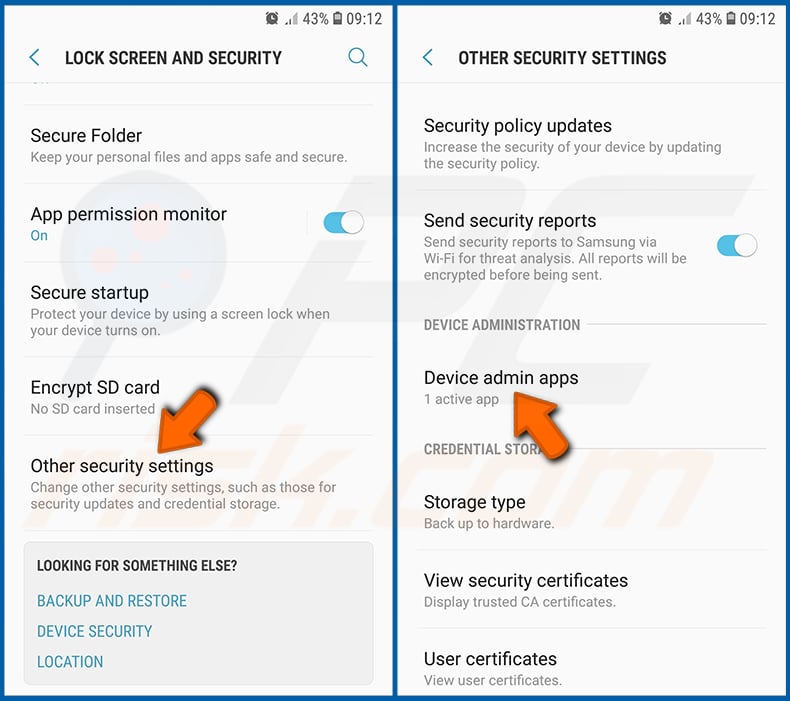
Scroll down until you see "Other security settings", tap it and so tap "Device admin apps".
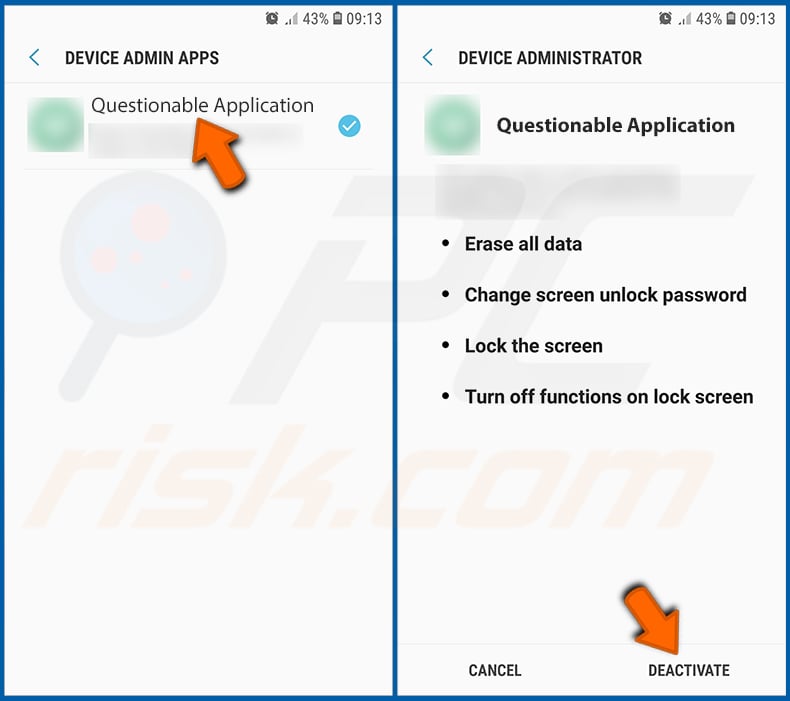
Identify applications that should not have administrator privileges, tap them then tap "Conciliate".
Often Asked Questions (FAQ)
What is a pop-upwards scam?
A pop-up scam is a deceptive message (usually a virus or fault alert) claiming that users need to remove malware, set certain errors or perform other actions to protect/fix their devices.
What is the purpose of a popular-up scam?
Most pop-up scams are used to distribute malicious software, extract sensitive information (for example, credit bill of fare details, account login credentials), promote questionable software.
Why practice I encounter fake pop-ups?
These scams usually are delivered by untrustworthy (deceptive, potentially malicious) websites. Users end up on such pages through shady ads or pages using questionable advertisement networks. They rarely are opened on purpose.
Near the writer:

Tomas Meskauskas - expert security researcher, professional person malware analyst.
I am passionate about reckoner security and technology. I take an feel of over 10 years working in diverse companies related to calculator technical issue solving and Internet security. I accept been working equally an author and editor for pcrisk.com since 2010. Follow me on Twitter and LinkedIn to stay informed about the latest online security threats. Contact Tomas Meskauskas.
PCrisk security portal is brought by a company RCS LT. Joined forces of security researchers help educate computer users about the latest online security threats. More information about the company RCS LT.
Our malware removal guides are free. However, if you want to support us yous can ship u.s. a donation.

Is The Mobile Cleaner Fast Repair A Scam,
Source: https://www.pcrisk.com/removal-guides/21704-cleaner-update-pop-up-scam-android
Posted by: mcgovernprocce52.blogspot.com
0 Response to "Is The Mobile Cleaner Fast Repair A Scam"
Post a Comment